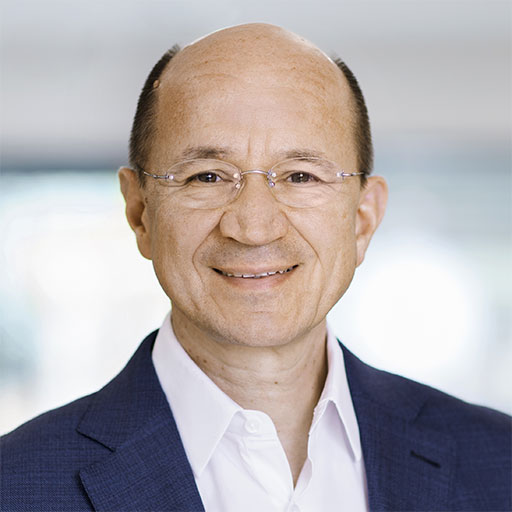
Where is communications management heading? Artificial intelligence will not reduce the need for strategic communicators – it will increase it. An interview with the trade magazine Kommunikationsmanager (issue 03/2026) aboutcommunicators’ professional identity and the relationship between communication and management.

Professor Ehrhart, you have announced that you will leave Bosch at the end of the year and focus more strongly on projects outside the company. What is at the top of your priority list for the coming months—as Chief Communications Officer and as a leader?
Christof Ehrhart: After three decades in international communications roles, I am about to begin a new chapter. I have served as Chief Communications Officer in the media, pharmaceutical and tobacco industries, aerospace and defense, logistics, and now at Bosch, a technology company. Since starting out in the 1990s, I have communicated in every phase of the economic cycle, from boom to crisis. Having quite literally seen it all as a communicator, I now want to share my knowledge beyond the confines of a single company. Effective communication has a major influence on developments in business and politics, and I can contribute in that regard. Until the end of the year, I will support the new Management to the best of my ability as it takes its first steps, while also working to make myself as dispensable as possible to my communications team. Announcing my departure has not changed my daily routine: my days still begin at 7:30 a.m. with the situation briefing for top management.
In your column for our magazine, you often address the mindset required in communications. What does that mean to you personally – what do you stand for as a communicator?
Christof Ehrhart: There has been a great deal of discussion recently about the mindset of communications professionals. Far less often do we consider whether there is a distinctly communicative perspective on issues – one that could also shape the contribution corporate communications makes to business performance. I see this as crucial to the development of our discipline, which is why I have spent my entire professional life reflecting on what defines this particular mindset. Ultimately, every communications professional will probably have to decide that for themselves. For me, it includes a passion for mutual understanding, a realistic view of human nature, the ability to question things on sound grounds and a belief in the value of a healthy public sphere. On a personal level, it requires above all intellectual integrity, the courage to be uncomfortable and perseverance in the face of resistance. Corporate communications is an endurance sport – with everything that entails.
Who has had the greatest influence on you as a communicator, and in what way?
Christof Ehrhart: Looking back over my education and career, I could name many impressive and influential figures – not least because I had the honor and pleasure of working with several leading figures in German business. But the list could never be complete, so I prefer to focus on a few very personal influences. As someone from the small region of Saarland, I come from a highly communicative family shaped by strong women, from my great-grandmother to my mother, who was exceptionally warm and communicative. “You drive cattle; you talk to people” was a popular saying in the rural area where I grew up, and my mother lived by it. She was very charming and often made the impossible possible for us. I would also like to mention my doctoral supervisor, Jürgen Domes, who died far too young. He insisted that his political science students express themselves precisely and encouraged critical thinking. His seminars featured legendary verbal battles – courteous in manner, uncompromising on substance.
Many communicators are currently unsettled by AI. You argue against that reaction. Does a clear professional self-concept help in a phase like this?
Christof Ehrhart: In my most recent column, I warned that our profession risks diminishing itself in the face of supposedly superior machines. I stand by that view: used correctly, AI is an effective tool for making communications more effective and efficient. But it cannot replace communicators. In fact, I predict that the need for capable communications managers will even grow at a time when companies need clearer direction. However, we must rise to the challenge and develop corporate communications from an instrumental discipline focused solely on achieving objectives into a strategic discipline that provides direction. Anyone who sees themselves merely as a PR machine operator pulling the levers of AI should not be surprised when people begin to ask whether the role can be fully integrated into automated processes.
In the age of AI, Germany is also wrestling with its identity as a centre of innovation. The persistent narrative is that the country has “already lost” the AI race. What can – or must – corporate communications achieve here over the next few years?
Christof Ehrhart: Progress in this field is undeniably impressive, and the current shift from generative to agentic AI appears revolutionary – not only in economic terms. AI will change the world, but the way it does so still needs to be shaped by business, politics and society. Because substantial sums are being invested, expectations of returns are enormous. At the same time, competitiveness in AI is playing an increasingly important geo-economic and geopolitical role. In such a setting, much of the debate is inevitably about managing expectations. This often means suggesting that the present necessarily determines the future. Given the capital and energy required, it currently seems rather unlikely that a superior large language model will emerge in Germany in the near term. However, recent developments already point to lower resource requirements, while quantum technology could bring another paradigm shift to which Germany can contribute its own expertise. Above all, AI can improve people’s lives to the fullest extent only if it also interacts with the physical world. The domain knowledge of established industrial companies therefore remains highly valuable – and Germany has plenty of it. Corporate communications must convey that confidence externally and help build internal acceptance of the responsible use of AI.
One project you intend to focus on more closely after leaving Bosch is the Günter Thiele Foundation, which you have chaired since 2024. The foundation promotes exchange between academia and practice in strategic corporate communications and aims to bridge the gap that still exists between the two. What causes this gap, and what is needed for effective knowledge transfer?
Christof Ehrhart: A great deal has already happened in this field over the past 30 years. Chairs have been established, degree programs created and a substantial body of work published. Günter Thiele, an influential figure in Germany’s still-young PR scene from the late 1960s onwards who inspired important practitioners, wanted to make a targeted contribution. His foundation has provided substantial support for the development of the Leipzig School of PR research, established and advanced by Professors Günter Bentele and Ansgar Zerfaß. As a result, the education of young communications professionals in Germany is now far more professional and academically grounded than when I took my first steps in PR. Initiatives of the Günter Thiele Foundation, such as the Academic Society for Management & Communication and the Centre for Research in Financial Communication, have promoted the transfer of key academic insights into practice – as well as practical experience into academic inquiry – through a wide range of studies and projects. One example is the Communication Value Circle, a concept for creating value through communication. Nevertheless, a gap remains, probably because practitioners can be sceptical of abstract theory, while academics can be distant from a practice that may appear largely as a craft. Together with my fellow board members, I want to continue closing that gap.
Which research findings does the profession find particularly difficult to put into practice?
Christof Ehrhart: It seems to me that there is now considerable openness to incorporating fundamental academic insights into corporate communications. The major paradigms have all arrived, and every CCO refers to them – from Noelle-Neumann’s spiral of silence and Watzlawick’s “one cannot not communicate” to Weick’s sensemaking and Grunig’s excellence theory, to name just a few. It becomes more difficult when specific models, such as the Communication Value Circle mentioned above, must be applied in day-to-day operations. In practice, the work is a blend of science, craft and art. Effective solutions are required under time pressure, and conceptual considerations can easily fade into the background in discussions with top management. That is why knowledge of how our discipline works and of its methods must be embedded much more firmly in general management education. I expect the next major step in translating theory into practice to come not only from expanding the skills of communications professionals, but above all from broadening general management’s understanding of communication.
Another focus of the foundation is education and the development of young talent. Junior positions are currently being cut – and with them the very learning environments in which people develop the methodological expertise, practical skills and judgement needed to use AI responsibly. Is the industry taking too short-term a view?
Christof Ehrhart: This question genuinely concerns me. Anyone with comprehensive responsibility for corporate communications today developed the necessary capabilities through a learning process lasting many years, sometimes decades. The most important skills – written and spoken language, as well as the broader understanding of communication needed for sound judgement in complex decision-making situations – were developed over long periods through trying, failing, improving and succeeding. AI now offers shortcuts, reducing what educationalists call the desirable difficulties of learning. Unless we counteract this, today’s generation of communicators will be the last able to use AI in a genuinely reflective way without surrendering to it entirely. Young talent needs opportunities, and cultivating sound judgement will become a new imperative in education. Strange as it may sound, technical mastery of communication can already be taken for granted in the age of digital media. Compared with when I started out in PR, the situation has been completely reversed.
The foundation brings management and communication together. Does communication too often lack a management perspective, and is that one reason why it still does not have the standing in companies that it claims?
Christof Ehrhart: Here, I would advise us to be more self-confident and shed fewer crocodile tears. I firmly believe that communications management can command considerable standing in companies today when it delivers results. The perpetual debate about our supposedly rightful seat at the Board of Management table does not help. We represent a specialized discipline with an inherent tension. On the one hand, our work is deliberately geared towards achieving objectives and using resources efficiently. On the other, we turn communication – a natural human characteristic – into an economic activity within a management discipline. This inevitably means that others may sometimes regard us with a certain unease, or that we ourselves may feel like the proverbial bird in an aquarium. Yet these contradictions are what make the task compelling and create the opportunity to make a unique contribution.
Does this difference in perspective begin during education and training?
Christof Ehrhart: It probably has more to do with different types of people. The path into communications management generally begins with an interest in language, communication and media, followed by the relevant education. That produces a different view of the world from one shaped by numbers, transactions and profit-and-loss statements. If you will, two cultures meet here, as C. P. Snow described them: the humanities and literary culture on one side, and the scientific and technical culture on the other. But that does not mean a fruitful symbiosis is impossible. On the contrary, we simply need to remain open to both worldviews and become familiar with their respective strengths. That applies to communications managers just as much as it does to business leaders.
Which other disciplines do you consider essential for learning to communicate well?
Christof Ehrhart: In times of fundamental change, good communication requires above all a realistic view of how things are and how they may develop. To achieve that, people need at least a broad understanding of the world around them. A grounding in political science, economics, business administration, history and public law remains very helpful. The ability to collect empirical data meaningfully – and above all to interpret it – will become even more important. What can unfortunately no longer be taken for granted is a sound sense of how the public sphere works. That requires disciplined media use: not relying solely on social media, for example, but reading at least one daily newspaper with concentration every day. I always tell my students in Leipzig that it takes at least a year before one can truly learn to read a newspaper profitably.
You have worked in communications for more than 30 years and taught for more than a decade. Which topics still excite you most today?
Christof Ehrhart: The communication taking place around me fascinates me as much as it did on the first day of my career – whether I am queuing at the bakery, presenting on stage or developing complex communications strategies. I find situations with few clues about future developments particularly exciting. Karl Weick calls this “thinking in the future perfect”: treating the future as though it had already happened and looking back at the present from that perspective.
You travel extensively for work. Which destination has remained particularly memorable to you, and why?
Christof Ehrhart: Two cities that have always fascinated me and that I have visited often are Hong Kong and Istanbul. There, the contrasts between tradition and modernity that have accompanied me throughout my professional life can be experienced first-hand. I have seen both cities as laboratories for the world of tomorrow – in every respect.
Looking ahead to the coming year and your next chapter, what are you most looking forward to?
Christof Ehrhart: Having more time with my wife and greater freedom to pursue exciting communications projects in academia and beyond. And being able to look out of the window at the snow-covered Brauneck mountain in winter and decide spontaneously: today, I’m hitting the slopes.
